7 year old creates his own level for ‘Edge’ →
Unique little design stories like these totally make my day.
Because the Lost craze kind of passed me by with little effect, TV and film writer Damon Lindelof didn’t ring a bell with me at first. But now he’s attached as the main writer for Prometheus, so I checked out his interview on the latest On the Verge podcast. Really good discussion here about screenplay, TV endings, living up to prequel expectations, working with Ridley Scott and much more.
Unique little design stories like these totally make my day.
Today’s console games push computing to the limit. But as fidelity and realism improve, the gaming industry demands higher quality voice acting. Troy Baker is one such voice actor heavily in demand and Joystiq looks into how he got his start. It’s an interesting read:
Around 2004, Baker “stumbled” into doing car commercials, which led to a chance encounter that would shift his entire career focus. “Since we were doing album work at the same studio, it was just right place right time. So I started doing commercial work, and met Christopher Sabat who plays Vegeta in Dragonball Z.” Soon he was cast in a slew of minor roles throughout the anime and video game world: various iterations of Dragonball Z, bit parts in Lupin III, roles in One Piece, Bloodrayne 2 and Mega Man X: Command Mission. Things started to explode, and did so with a sonic boom when he was cast as the memorable Frank Archer in Fullmetal Alchemist.
Matt Zoller Seitz, wrapping up his recap of Mad Men’s “The Other Woman”:
I want to go on record saying how flat-out amazing this season has been…Something Sgt. Peppers-level major is happening on Mad Men this year, a seismic creative flowering comparable to season one of The Sopranos and season three of Breaking Bad. Every season five episode is a creative experiment that draws on the cumulative power of every episode that preceded it. We’re nearing the point where everything on Mad Men seems to connect to everything else — not just from episode to episode within season five, but backwards, as if the new episodes are somehow unfurling tendrils into the past, fusing the whole run of Mad Men into a fiendishly intricate mega-story. It’s just extraordinary.
Damn right. I rarely get those “on the edge of my seat” moments when watching TV. Yet it happened with the The Wire, season four. Breaking Bad, season three onward. And now I can clearly add season five of Mad Men. We’ve had a few so-so episodes (e.g. “Hare Krishna” from last week), but many extraordinary ones: Signal 30, Far Away Places, and now The Other Woman.
There’s been a lot of critical breakdown of The Avengers success, but The House Next Door’s Ted Pigeon really nails it:
As you might guess, just about every plot turn is recycled from other fantasy or superhero stories…But it’s worth noting that Whedon, to his credit, never pretends that the story arc is particularly significant. He instead supports it from the bottom up, with solid structuring and careful characterization. For example, despite a weak plot, Whedon gets all the mileage he needs out of Hiddleston’s exceptional performance. He bellows phrases like “Kneel before me!” about as convincingly as an actor can, and his demonic smile works to great effect when beaming through that metal-horned helmet of his.
How often do we see such a strong directorial hand or style in a $300 million plus summer blockbuster? Exactly. Without Whedon, The Avengers would have been merely average.
I’ve already plugged the excellent film podcast Battleship Pretension enough here, but this week’s episode was awesome. It’s all about film scores with deep analysis and extended audio clips.
I haven’t bought into integrating a standing desk routine into my workflow yet. That attitude may change with this extended article at Brain Lam’s The Wirecutter. Breaking from its usual review heavy content, author Mark Lukach spends the first half of the article diving into standing desk health benefits and general best practices.
I’m pleased to launch a little project I worked on over the weekend. I called it Blue Drop, and it’s a colorful, simple weather app that’s accessible anywhere you have a web browser. It looks best on an iPhone, iPad, or Webkit (e.g. Safari, Chrome) browser on your desktop. It’s far from revolutionary, but it matches my needs and may match yours as well. On this post I want to break down how it came together and my development workflow.
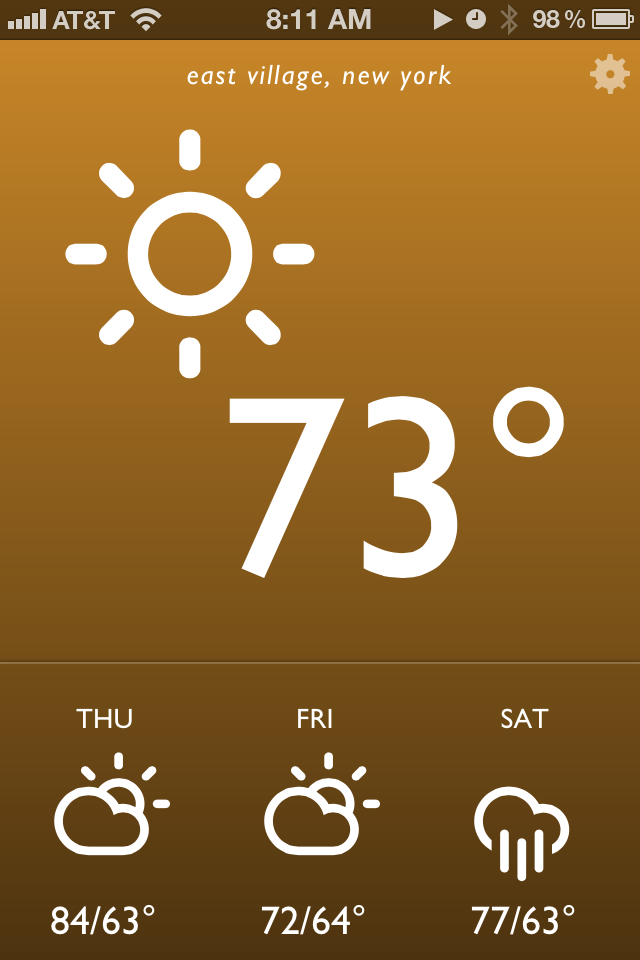
To give a bit of background info, the idea of a self written weather web app or page had been ruminating in my brain for weeks. I’ve been extremely disappointed by options on the web store. Most weather apps are poorly designed, hard to read at a glance (small text is the common culprit) filled with ads, and tend to provide either too much or too little information. Then a breakthrough came last week – I spotted Degreees, a clever, CSS3 powered web app that relies on geolocation to report local temperature. I knew this was exactly the kind of direction I wanted to go in, but with my own personal spin.
Before I started designing mockups, I jotted down in iA Writer a few attributes of what an ideal weather app would have. It should be reliable and get its weather information from a great source. I’ve always been a fan of Weather Underground’s data so they were a logical choice. Their api is free for developers to try out as long as your daily query size is small. I also wanted a pared down app that gave me quick information at a glance. No maps, no extended forecasts. Just the temp, conditions, and a quick forecast of the near future. Finally, I was heavily inspired by the Windows Phone Metro style UI: big typography, big iconography and a sparse color palette.
I next used Sketch for mockups and wireframes. Based on some searching I settled on Adam Whitcroft’s gorgeous Climacons for icons, and the well tested Gill Sans for typography. Helvetica is a more readable choice but I wanted a mildly warmer and more humanist font. Development was done locally on my Macbook Air with my usual tools: Sublime Text 2, Kaleidoscope and SnapRuler.
The finished app has a few small touches that I think both add personality and increase its usability. First the background gradient changes color depending on both the time of day and the weather conditions. Sunny days have an orange hue, clouds and rain get blues and grays, and thunderstorms are purple. Daytime has bright, punchy colors while saturation and darkness decrease during the evening. The interface is also intentionally simpler than most iPhone apps – this made development and QA more straightforward as well. Everything essential is presented on app launch, and a single tap or click on one of four regions (the top conditions area and the three daily weather icons below) toggles additional detail.
There are still a few rough issues; they mostly deal with the size and space of several icon related items that I expect to touch up in upcoming weeks. For now, feel free to check it out and pass along any feedback.
Startup entrepreneur Ilya Lichtenstein on the effects of him picking up basic programming skills:
The lessons I’ve learned from actually building and launching products are invaluable.
I never ask for specific estimates or set hard deadlines for finishing a project. I know firsthand that the last 10% of a project can take 90% of the time.
I don’t say things like “This looks really easy to do, you can throw it together in a couple hours, right?” The most complex projects can look deceptively simple.
Exactly. I’ve worked directly with and for a business almost a decade now. Once you have as little as one or two decision makers on the business side with a technical background, it can have a huge positive effect on relations with the tech team.
Pretty brilliant Reddit comment thread that made its way around the internet yesterday:
It’s well known that all of Tarantino’s films take place in the same universe – this is established by the fact that Mr. Blonde and Vince Vega are brothers, everybody smokes Red Apple cigarettes, Mr. White worked with Alabama from True Romance, etc.
As it turns out, Donny Donowitz, ‘The Bear Jew’, is the father of movie producer Lee Donowitz from True Romance – which means that, in Tarantino’s universe, everybody grew up learning about how a bunch of commando Jews machine gunned Hitler to death in a burning movie theater, as opposed to quietly killing himself in a bunker…
…What immediately springs to mind about Kill Bill and From Dusk ‘Til Dawn? That they’re crazy violent, even by Tarantino standards. These are the movies produced in a world where America’s crowning victory was locking a bunch of people in a movie theater and blowing it to bits – and keep in mind, Lee Donowitz, son of one of the people on the suicide mission to kill Hitler, is a very successful movie producer.
We’re going way down the rabbit hole here. If you have even a passing curiosity about Quentin Tarantino’s films, check this out.