E3 was fairly low key this year. In place of big reveals or surprises, we saw a solid suite of games as the current console generation hits its full stride. Two narratives stood out: Microsoft is staying in the game, and we’re getting next generation consoles sooner than I originally expected.
Microsoft’s best presser of the generation
Microsoft’s overall E3 message was one of strength and confidence for both the present and future. Their press keynote reassured Xbox loyalists and anyone else considering a dip into the Xbox ecosystem.
Granted, Microsoft’s keynote on paper shared the same DNA as their last few: trailer after trailer for solid third party games. It’s an obvious move given their competition moved in a different direction at E3 this year: Nintendo stuck to Smash Brothers while Sony focused on first party titles. But this year had especially strong game variety and pacing. The presser got virtually every third party game of interest through next year. Closing with Cyberpunk 2077 — hands down the most buzzed about game at E3 — was a masterstroke.
At a glance, Microsoft had a decent E3. Their presser showcased a huge number of quality games, solid genre diversity, and decent pacing. Xbox head Phil Spencer remains a great ambassador for the brand. And the Xbox One X looks to be an engineering marvel, a cutting edge console in a svelte enclosure.
But Xbox doesn’t exist in isolation. Sony is well ahead in mindshare and sales. Nintendo surprised many (myself included) with the runaway success of the Switch. With E3 over, Microsoft has two chief questions to answer. Why should anyone buy an Xbox One X? And why invest in Xbox over the PS4?
Sadly, Microsoft stumbled on both questions. Like I wrote earlier, by leaning so heavily on 4K, Microsoft has put themselves into a weak position for the holidays.
The PS4 Pro has serious potential. It has decent internal specs, a reasonable price point, and follows the popular base PS4. But we’re a less than a month away from the release date, and Sony’s marketing and PR wing feels asleep at the wheel. Performance claims, especially for those without 4K displays, are vague. And there’s few titles or publishers with Pro enhanced games ready for 2016. As someone bullish on a more iterative console cycle (for both Sony and Microsoft), that’s worrisome.
Granted, tech and home theater enthusiasts in the market for a PS4 won’t hesitate for the Pro. They already own 4K set or PS VR, or plan an investment in either over the next year or two. But this is a niche minority of potential buyers. For everyone else, Sony needs to step up its game and provide more information.
The Pro isn’t a routine tech release. This is the first time two consoles both labeled “PS4”, with the same game library and similar feature set, are on sale side by side. Yet one has $100 price tag for premium performance. That’s commonplace in consumer tech, but a first for game consoles. And consoles historically are very sensitive to price differences. Unless the marketing situation changes, I see few outside the enthusiast market paying extra for the Pro.
Microsoft’s E3 announcement of Project Scorpio is big news. It’s the first official sign of consoles moving toward a faster, more iterative release cycle. But the announcement is also a big strategic mistake.
Not because of the Scorpio concept itself. Consoles have advantages with a faster release cadence. There’s more wiggle room for innovation and breakthrough gaming experiences. Game compatibility expands; older platforms aren’t immediately left behind.
Yet I see two big errors on Microsoft’s part. They announced Scorpio too early and are targeting a high end, costly specification.
The maturity of the console market and strong sales clearly rubbed off on the Microsoft and Sony this year. Each had their missteps, but they stayed on message and were the most interesting pressers by each company in several years.
Yet Sony and Microsoft took different approaches. Microsoft knows it’s well behind Sony and wanted to present a wide net for potential buyers. They succeeded; onstage content was bright, fun, and diverse.
Sony had the swagger of being in the lead. While Microsoft went wide, Sony went uncharacteristically narrow and minimalist. PlayStation VR got a mention, but the focus was otherwise all on games, many of them first party exclusives.
Giant Bomb confirmed an upgraded PS4, codenamed NEO, is real and coming soon. There’s still a lot we don’t know, but based on the leaked developer guidelines, I’m cautiously optimistic about this news. However, a shift to a more iterative console isn’t won through hardware or development studio relations. It’s with marketing to gamers and the larger public. And it’s on that angle Sony can turn this into a mess.
Strong E3 showings generate hype and set a company’s aspirations for the future. On that count, it’s hard to fault Sony’s strategy. They focused on a few hugely anticipated game announcements: The Last Guardian, a Final Fantasy 7 remake, and Shenume 3. Just one would have made many PlayStation fans happy, but we saw all three at once. Alliances with this year’s biggest third party releases (e.g. Batman, Star Wars) underline Sony’s status as the console market leader. And an upcoming exclusive, the futuristic RPG Horizon: Zero Dawn, was an E3 highlight.
Yet all the hype and big games for the future can’t mask Sony’s lack of big exclusives for 2015. That’s a problem given Microsoft’s strong lineup this year. And beyond the mega announcements, I found stretches of Sony’s E3 presser poorly focused. We barely saw a mention of Project Morpheus. There was little stage time for indies, far less than Microsoft. And Sony relegated 2015 exclusives like The Nathan Drake Collection to a few seconds of a sizzle reel.
I expect stability and predictability from the big three (Microsoft, Nintendo, Sony) E3 pressers this year. First, we’re a year and half into this generation. It’s past the bumpy launch window, but not far enough for new hardware iterations. PS4 and Xbox One sales are already strong, which reinforces a conservative playbook. And many games for the show have been formally revealed early or leaked. Yet there are unknowns that the pressers next week could help answer.
It’s clear the PS4 is an unqualified sales success. It’s sold around ten million units, roughly 2 to 1 against the Xbox One. Those are impressive enough sales to be a key factor in Sony’s profitability for Q1 2014 after years of losses.
But even hit consoles need work; almost a year into its lifecycle, the PS4 needs to improve its user interface. As I’ve argued previously, the UI gets the job done as a quick, no-frills game launcher. Yet its “horizontal ribbon” layout, with every app (in this post, ‘app’ is a loose interpretation encompassing both games and entertainment apps like Netflix) on the system ordered in strict reverse chronological order, is hampered by its lack of customization (note the upcoming major UI update, as of this writing, doesn’t alter the app layout at all.)
Customization matters
Core gamers, often with large game libraries, have the most immediate demand for a more organization-friendly UI. Yet it’s not just a traditional fan base that may juggle between many apps. Popular premium subscription services like PS Plus, Xbox Live Gold and the recently announced EA Access offer new “free” game downloads at regular intervals as long as you’re a member. And casual gamers that only buy a few $60 AAA titles may buy more games as inexpensive and free-to-play indie titles proliferate on the PSN store.
Also, in 2014, customization isn’t just a nice to have, it’s essential to the DNA of most modern tech gear. Every smartphone, tablet, or laptop allows you to organize apps into folders or across multiple home screens. If I’m paying the same price for a dedicated gaming console as I am for the next iPhone, I expect basic levels of customization to define it as my own.
There’s a philosophical argument as well: gaming is going through the same pattern as all media post-internet, splintering into fragmented, niche genres. With so many on the same base console but able to purse much more individualistic tastes, some basic UI customization helps distinguish my PS4 from somebody else’s.
A multi ribbon interface
With such a large install base, major UI changes can be tricky. Thankfully, the UI doesn’t need a redesign from the ground up, just evolutionary growth into a multi ribbon system. Users create as many additional ribbons as they want and move apps to any ribbon they choose. To keep things straightforward, like with iOS, there are no extra “shortcuts” or “aliases” of app icons, only a single canonical icon within a set of ribbons.
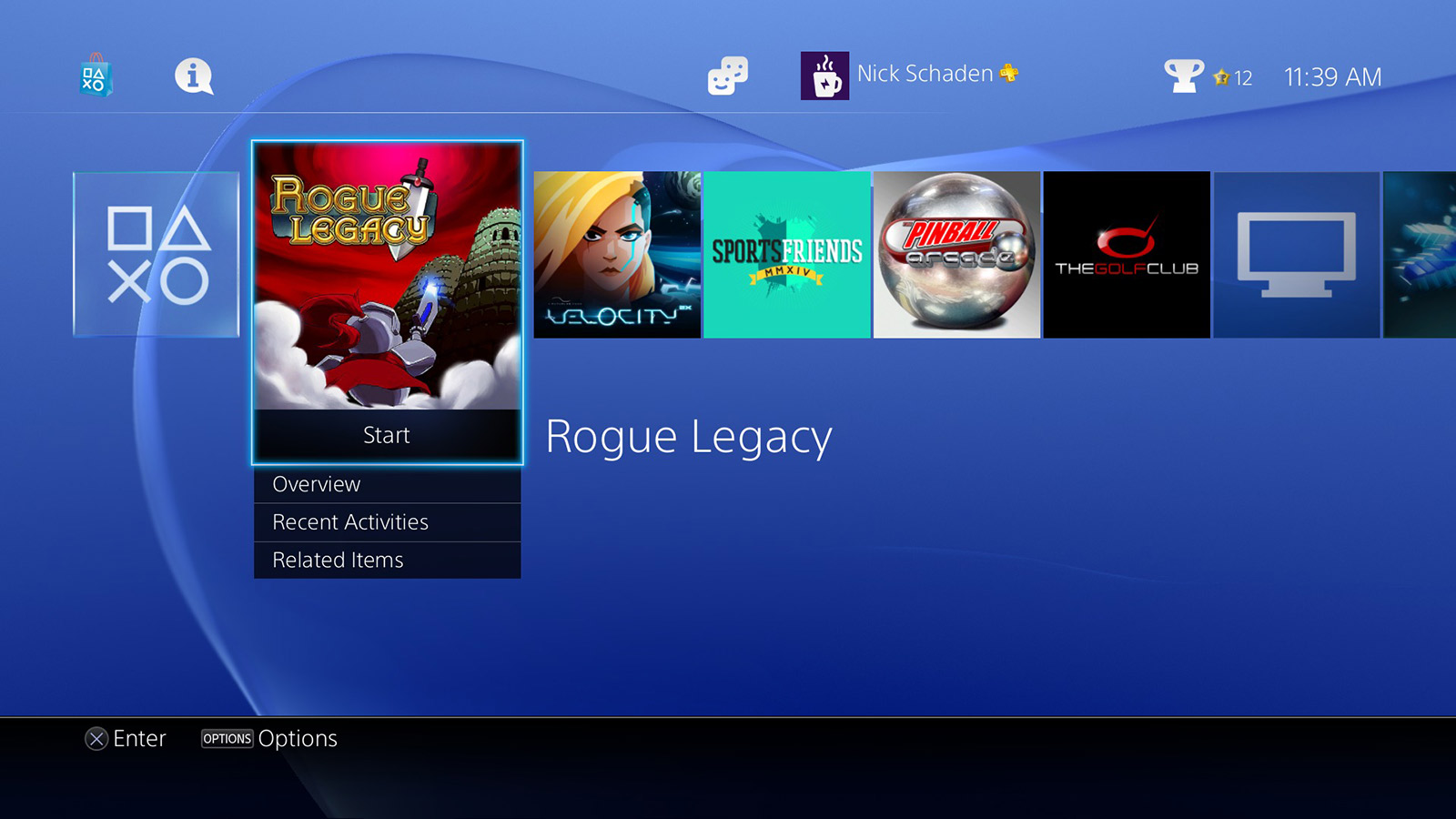
The original, single horizontal ribbon remains unchanged by default. Navigation and controls are identical to before, retaining the three row structure: settings, notifications and trophies are in the top row, apps in the middle, and details on an individual app or game at the bottom (figure A). Only one ribbon appears at a time.
Figure A: Start state of the proposed UI
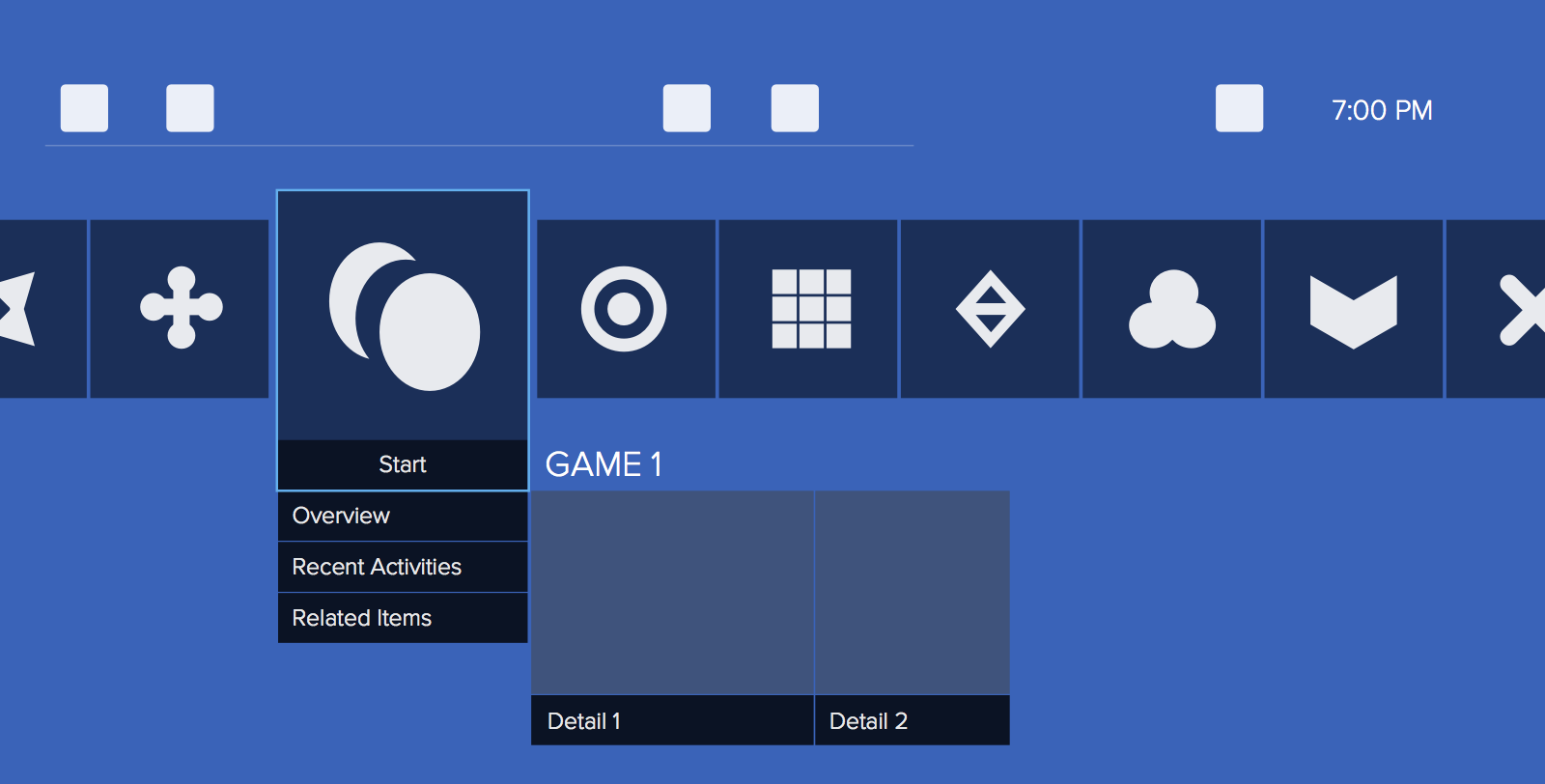
Users tap the DualShock controller triggers (L2, R2) or speak voice commands to cycle through their ribbons. As each ribbon appears, the scrolling text region in the screen’s top left briefly displays the ribbon name (figure B).
Figure B: user jumps to a new ribbon
Reordering games and editing ribbons
To reorder apps in a single ribbon or move an app to another ribbon, users enter a special “app reorder mode” by holding both DualShock bumpers (L1 and R1) down for a few seconds. This is a nod to the “hold an icon until it wiggles to edit” paradigm in most mobile OSes.
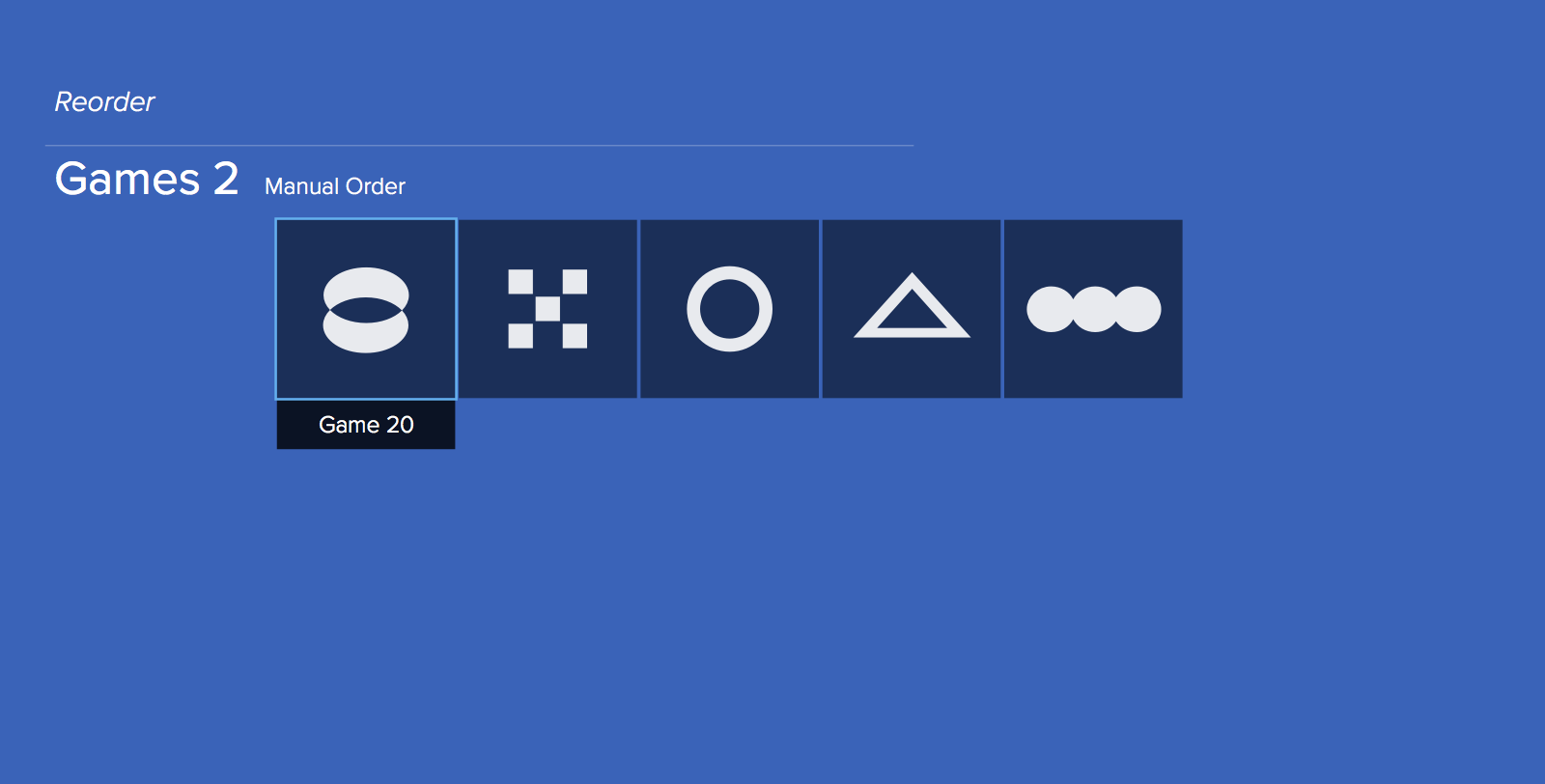
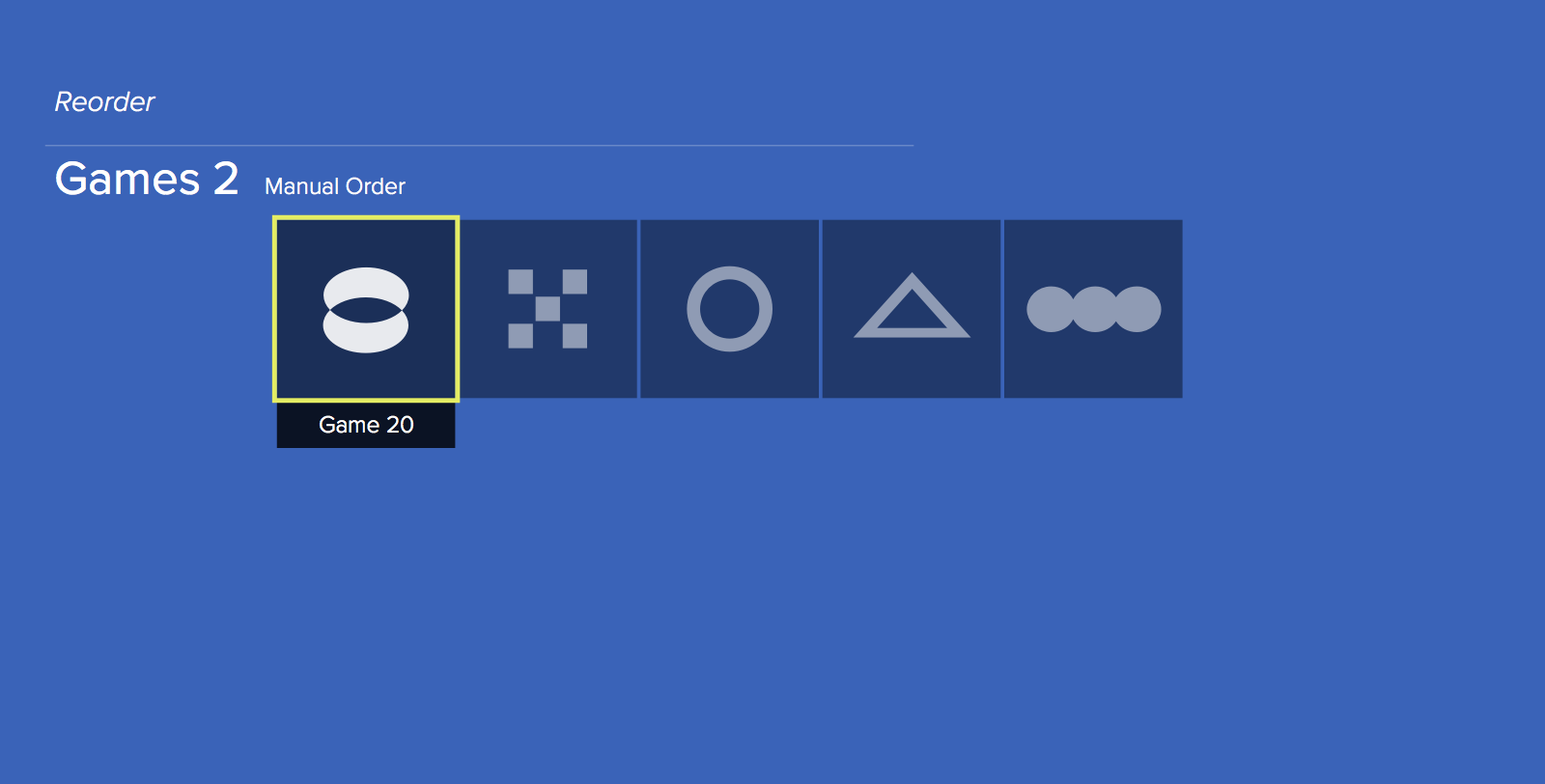
The UI’s look in this mode changes significantly: the top and bottom rows are removed and the app icon the cursor is selecting no longer enlarges the icon. In addition, new text labels are added around the ribbon to clarify the name of the active ribbon and its order (Figure C).
Figure C: app reorder mode
A new, simplified control scheme applies in this mode:
Controller bumpers cycle through the current ribbon’s order options: chronological (default), alphabetical, and manual.
X selects an individual app for movement.
Options opens up a menu to change the current ribbon’s name. Upon creation, all ribbons have an automatic, sequential ordering naming convention like “Games 4” and “Games 5”. But for users with a lot of content or who want a particular organization, custom labels are helpful.
The D-pad and analog sticks navigate between ribbons (up/down) and individual apps on a ribbon (left/right).
Square exits app reorder mode.
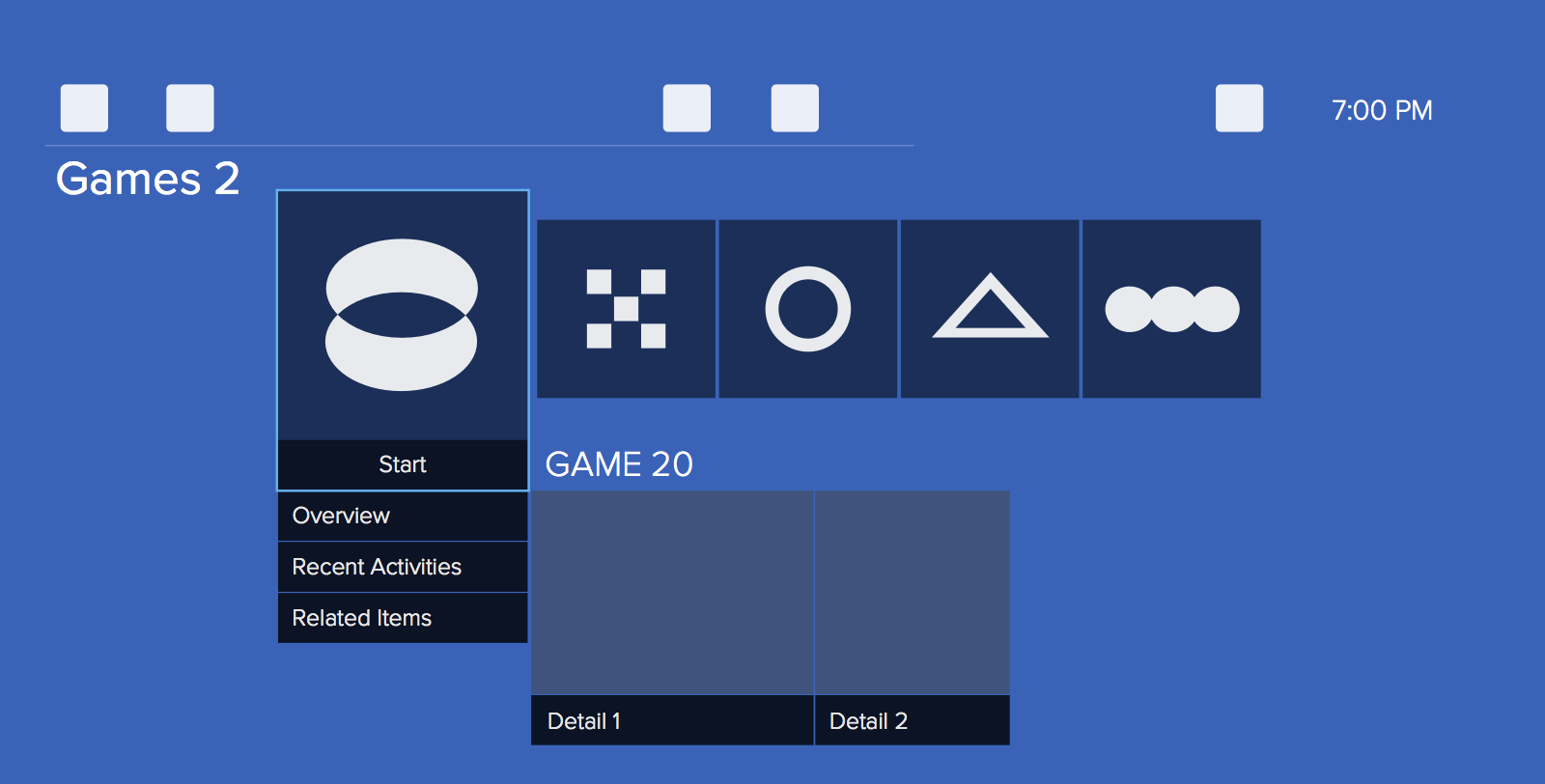
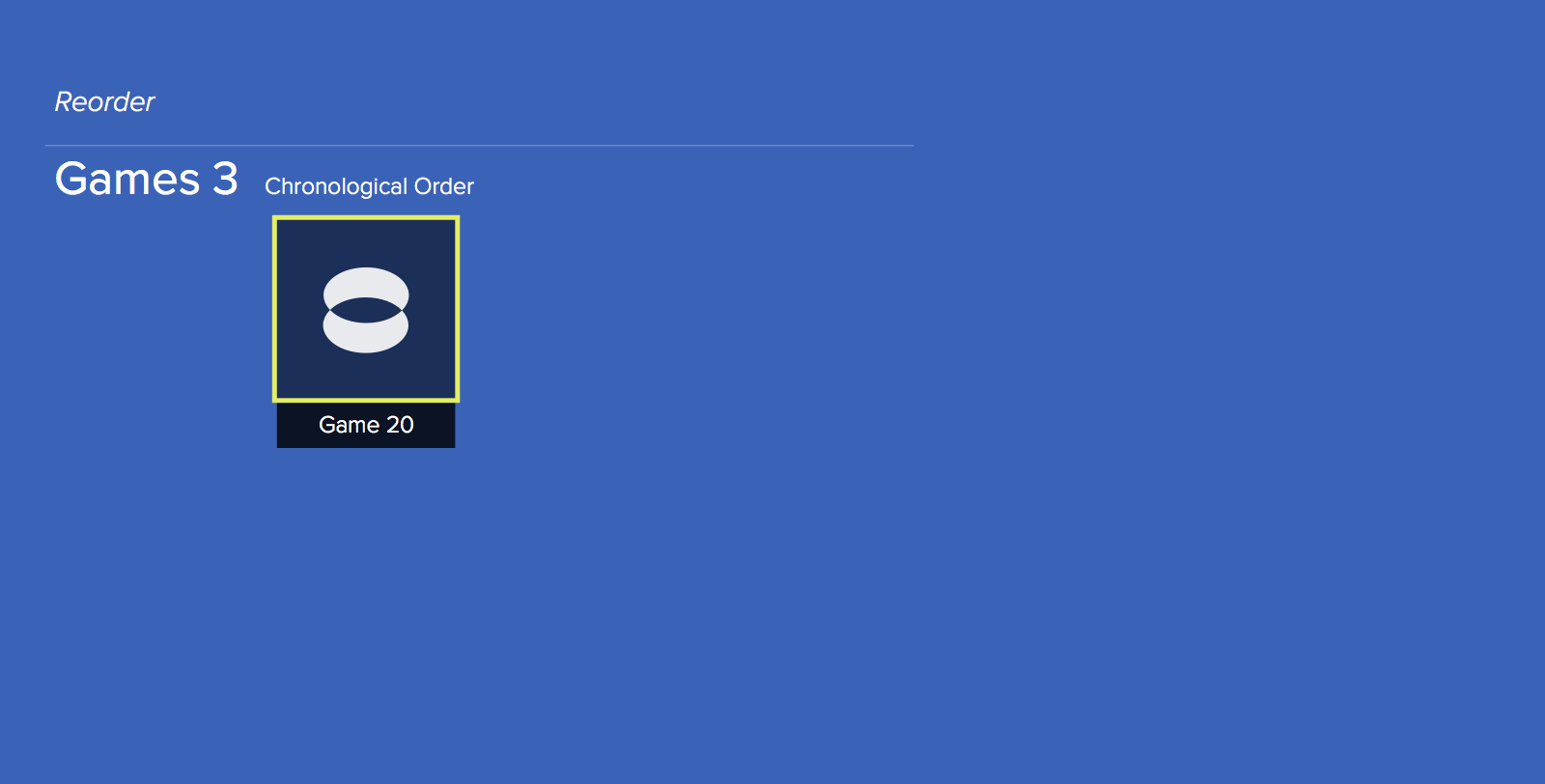
Once an icon is selected, a visual change (e.g. change in selected icon border color or thickness, icon appears to hover) indicates it’s available to move. Up and down always shuffles the app between ribbons. To keep things simple, the ribbons cycle with a definitive beginning and end; the first is at the top, the last is at the bottom and there’s no looping. This way, to create a new ribbon, all it takes is moving ‘down’ from the last occupied ribbon (figure D, E). Conversely, to remove a ribbon the user removes all icons from it.
Figure D: Game 20 is selected, ready for movement.
Figure E: Moving Game 20 "down" once auto creates a new ribbon.
Small change, big impact
Adding smarter organization isn’t going to move the needle for PS4 sales. Nor is it likely to affect Sony’s ongoing battle against the Xbox One, a fight centered on game selection, exclusives, and raw performance. Instead, a stronger UI makes users happier while improving their attachment to the device. For a dedicated gaming console in an increasingly mobile-centric world, that’s an underrated, compelling factor in the long run.
The “day zero” E3 press conferences by the big two console manufacturers feel like a relic of the pre-digital era: largely predictable, bloated, expensive, and with a lot more emphasis on style and spectacle over details. Yet they’re still important to set the tone and general focus of the Xbox One and PS4 platforms over the next year. In that regard, both Microsoft and Sony had solid, if unspectacular, B grade efforts. Microsoft played it safe but remained extremely polished and focused in the process. Sony had some more interesting, diverse announcements but were marred by some poor pacing and presentation.
Microsoft
Judged strictly by presentation alone, Microsoft handily trumped Sony this year. To answer criticism from last year, they stayed laser focused on games. Though their briefing lasted over 90 minutes, it rarely dragged, with well-crafted transitions and trailers between the larger titles. Xbox head Phil Spencer was clearly on a mission to woo core gamers back to Xbox, and it did so by playing to traditional Xbox boilerplate: racing games, first person shooters, and fantasy medieval combat.
Yet even with a solid effort, Xbox’s exclusives felt underwhelming and almost completely unsurprising. Forza Horizon 2, Crackdown, Fable Legends and The Master Chief Collection are sequels or reboots on existing IP. They’ll likely be fun, but it felt like safe genre territory Microsoft has heavily covered in the past. Also, as more third party publishers go multi-platform, we’ll see Microsoft’s genre reboots overlapping with other publishers (e.g. Ubisoft’s The Crew in the same space as Forza Horizon 2, Bungee’s Destiny competing with Halo 5). Die hard Xbox 360 fans now have stronger reasons to make the jump to the Xbox One now versus last year. But without a clear exclusives victory on sheer numbers or originality, I don’t expect Microsoft to sway those on the fence between the Xbox One and PS4.
Sony
In contrast to Microsoft’s showing, Sony, at least on paper, presented a more interesting set of games. Their exclusives were fewer but packed serious punch: Grim Fandango is a classic, cult adventure game from famed designer Tim Schafer and was potentially the biggest surprise of the day. No Man’s Sky is a very unique, indie sci-fi darling and potentially more ambitious than any game shown at E3. Then there’s Bloodborne, a gory RPG from the creators of Demon’s Souls. Round that out with a few anticipated indie exclusives for 2014, most notably Hotline Miami 2, and Sony showed off an exclusive (albeit occasionally timed or console only) roster that was more diverse and daring than Microsoft. And Sony was able to go toe to toe with Microsoft on their own set of exclusive betas and DLC for a few big name AAA games—likely a reflection of Sony’s stronger momentum and sales heading into E3.
Almost all those news was revealed in the first hour. Then came a lackluster middle section that dragged with a scattershot focus and left viewers with more questions than answers. They hawked a graphic-novel TV series with only concept art to show; its ten minutes on stage killed the presser’s momentum. A firm date was set for an “open beta” for the Playstation Now streaming service but few details on games and pricing were offered. The Project Morpheus VR platform was glanced over while Sony’s Andrew House punched down at the Xbox’s Kinect. The PS Vita was mostly ignored; no bundle with the PS4, no price drop, and few standout games.
Moving forward
Overall, Sony’s presentation felt like a slightly larger missed opportunity compared to Microsoft, but neither side was particularly earth-shattering. One factor this E3 has made clear is that many hyped games have been pushed back well into 2015, so it’s unlikely Sony or Microsoft will have a big system seller on its hands this year. There are two notable exceptions: Destiny (a strong performance could overshadow the Halo series and thus help Sony) and The Master Chief Collection (which, if Halo fanatics show up in droves for, could help Microsoft close the gap.) Either way, it’s going to be fascinating to see how each company positions their consoles this holiday season. It’s smaller, intangible factors that could now make a deciding difference among those that haven’t jumped in this console generation.